Posts Tagged ‘John Dillinger’

Aug 05

John Dillinger’s John Thomas

Posted by Tom Lennon in Films

He vould have an enormous schwanzstucker

- Young Frankenstein

I finally went see Public Enemies last week, Michael (“L.A. Takedown“) Mann’s new film about Depression-era bank robber John Dillinger which stars Johnny (“Nightmare on Elm Street“) Depp and Christian (“You and me – we’re done professionally“) Bale.   It’s a smart, sophisticated and visually stunning slice of grown-up entertainment and one of the few things on at the multiplexes right now that doesn’t assume you’ve got the attention span of a coke-fiend and the emotional range of a used paper cup.   It’s currently showing at a cinema near you (see local press for details), but it probably won’t be for much longer.  You really should try to catch it on a big screen – and preferably one with digital projection – while you’ve still got the chance.  Unless, that is, you happen to have the attention span of a coke-fiend and the emotional range of a used paper cup.

Public Enemies isn’t the first film to deal with the colourful life of John H. Dillinger, and it probably won’t be the last, either.  One of the many things that makes it stand out from previous attempts is the way in which it tries to strip away the accumulated layers of unsubstantiated myth and Goddamn bullshit that an urban folklore A-Lister like Dillinger invariably attracts.  Of course, that’s the sort of thing that Michael Mann likes to do.  This is a serious filmmaker who makes serious films about serious men with serious problems:  he’s not the sort of cheap hack or charlatan who’d fob his audience off with a lewd, bizarre and highly unreliable yarn about Dillinger just because he thought it was funny.

Which, of course, is just what I intend to do.

Like some kind of phallic space rocket, the legend of John Dillinger’s Pickled Penis consists of three distinct yet interrelated modules:

  1. Depression-era bank robber John Dillinger had an unfeasibly large shlong.
  2. Following Dillinger’s death, FBI Chief J. Edgar Hoover arranged to have it surgically removed.
  3. This ithyphallic monstrosity was subsequently put on display at the Smithsonian Museum.

Like most urban myths, there’s little in the way of hard evidence (ahem) to support any of this.  To tackle (if you will) the first part of the legend – upon which, its fair to say, the rest of it hangs (so to speak) – there’s not so much as a post-coital testimonial from a grateful gangster moll to support the theory that John Dillinger was equipped with a monstrous junior partner.  The closest we get to  ‘proof’ is a grainy black and white photograph of Dillinger’s recently-expired corpse that was taken in Cook County Morgue in 1934. For some strange reason it was only after the photo was published in newspapers that the rumour began to spread.

This is the photo:

John Dillinger at Cook County Morgue

As Rolf Harris might say:  “Can you tell what it is, yet?”

Of course, even if this photo was the catalyst for over half-a-century’s worth of pecker-speculation – which, it must be said, seems fairly unlikely – it’s hard to imagine how it subsequently gave rise (groan) to the rest of the legend.  How do you get from ‘America’s Public Enemy Number One might have been the proud owner of a colossal ding-dong’ to ‘It was surreptitiously lobbed-off by the alledgedly cross-dressing head of the FBI’?   And how did it get from there to the Smithsonian Museum?

In a jar filled with formaldehyde, I suppose.

It could have something to do with Jungian archetypes, I suppose.  Dillinger was, after all, often portrayed as a 20th Century Robin Hood; maybe this lurid myth is just a modern variation Robin Hood’s final blind arrow shot?  Then again, it’s not what you might call a like-for-like comparison:  sightlessly shooting an arrow to determine the your burial site isn’t quite the same as already being dead and having your prized possession chopped off by the Feds and put on display.  Maybe I should leave the Jungian archetypes to the Jungian archetypists.

At least the excellent myth-busting website snopes.com offers a more robust psychological take on the bizarre affair:

Although the FBI finally caught up with and killed the infamous gangster in Chicago [...] he had given Hoover and the FBI a black eye, leading them on an extended merry chase across the Midwest and humiliating them by escaping yet again when they had him cornered.  What better revenge for Hoover than a symbolic emasculation, especially considering that it was a woman whom the FBI finally used to lure Dillinger to his death?  Spread the word that Public Enemy Number One had been interred sans penis, and that his manhood had been put on display for all to see right across town from FBI Headquarters in Washington, DC.

If you ask me, that’s a pretty good explanation for something that probably isn’t true.

Jun 22

John Dillinger Died For You

Posted by Tom Lennon in Films

public-enemies

Seventy-five years ago today, the notorious American outlaw John Dillinger was shot to death by FBI agents as he was leaving the Biograph Theatre in Chicago, Illinois.   The film Dillinger was watching was called Manhattan Melodrama, which went on to win Academy Awards for Best Screenplay, Best Original Story and Best Tasteless Marketing Campaign  (1935).  Nobody knows whether Dillinger liked the film, but this was probably due to the fact that FBI Chief J. Edgar Hoover had ordered his G-Men to adopt a strict policy of  “Shoot first, ask critical opinions later”.

Tonight, a silent vigil will take place outside the Biograph Theatre, Dillinger’s final croaking spot.  If that sounds like too much trouble, you can always wait until next week and go see Public Enemies, Michael Mann’s gangster epic that stars Johnny Depp as Dillinger.  With any luck you won’t be shot as you leave the cinema.

Upon reflection, I suppose this renewed interest in Dillinger is quite timely.   Dillinger, after all, came to prominence  during a period of tremendous economic hardship.  Financial institutions were going to the wall and bankers and politicians were as popular as turd souffle.  In this climate, someone like Dillinger could be regarded as something of an urban hero.  Instead of letting a collapsing economy get to him, he took matters into his own hands.  Sure, he stole money, but at least he did it with a certain style and charisma and was always above board when it came to matters of disclosure.  He never lied about where the money came from.

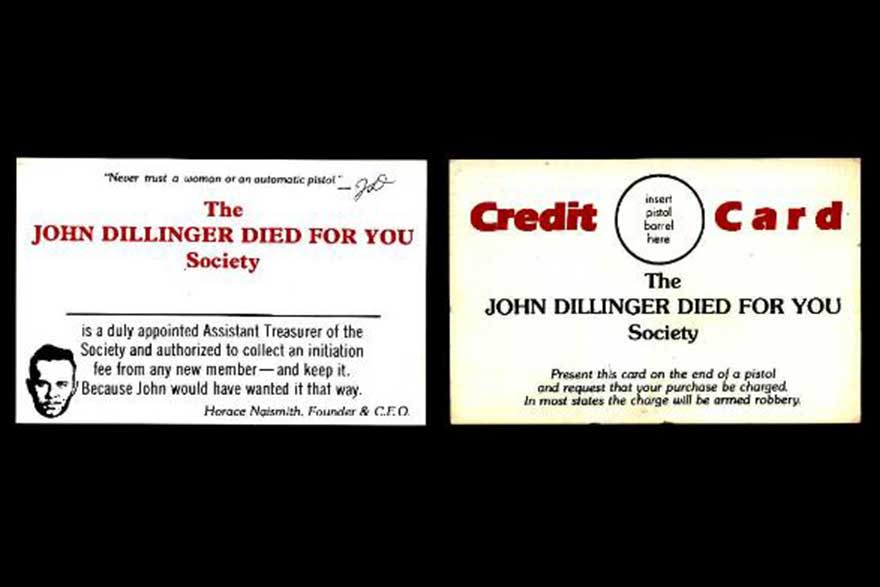
Last night’s vigil was organised by the John Dillinger Died For You Society, one of those 60s counterculture mischief-making enterprises like Discordianism and the Church of the Sub-Genius that I’ve always been rather fond of.  According to Robert Anton Wilson:

The John Dillinger Died For You Society, run by a pseudonymous “Dr. Horace Naismith” (allegedly a Playboy editor by day and a maniac only by night), accepts as its savior John Dillinger, the gunman who robbed 23 banks and three police stations before he was shot dead by FBI agents in 1934. JDDFYS members place memorial wreaths and floral bouquets at the Biograph Theater, where Dillinger was gunned down, every year on the anniversary of his death, June 22. Their major spiritual teaching comes from Mr. Dillinger, whom they call St. John the Martyr, and consists of the words, “Lie down on the floor and keep calm,” (St. John said this often to nervous and agitated bank officials before looting their tills). Every member ordained by Dr. Naismith gets a membership card making him or her an Assistant Treasurer, entitled to collect tithes from any new disciple naive enough to remain a disciple and not become an Assistant Treasurer, too, by writing to Dr. Naismith for a card.

Dillinger certainly had a way with words.  When it comes to quotes and aphorisms, he was something of a cross between Oscar Wilde and Raymond Chandler.  My favourite Dillingerism has always been:

“You get more with a simple prayer and Thompson sub-machine gun than you get from a simple prayer alone.”

As other people smarter than me have noted, this seems to sum up the foreign policy of most countries.