Posts Tagged ‘Robert Anton Wilson’

Jun 22

John Dillinger Died For You

Posted by Tom Lennon in Films

public-enemies

Seventy-five years ago today, the notorious American outlaw John Dillinger was shot to death by FBI agents as he was leaving the Biograph Theatre in Chicago, Illinois.   The film Dillinger was watching was called Manhattan Melodrama, which went on to win Academy Awards for Best Screenplay, Best Original Story and Best Tasteless Marketing Campaign  (1935).  Nobody knows whether Dillinger liked the film, but this was probably due to the fact that FBI Chief J. Edgar Hoover had ordered his G-Men to adopt a strict policy of  “Shoot first, ask critical opinions later”.

Tonight, a silent vigil will take place outside the Biograph Theatre, Dillinger’s final croaking spot.  If that sounds like too much trouble, you can always wait until next week and go see Public Enemies, Michael Mann’s gangster epic that stars Johnny Depp as Dillinger.  With any luck you won’t be shot as you leave the cinema.

Upon reflection, I suppose this renewed interest in Dillinger is quite timely.   Dillinger, after all, came to prominence  during a period of tremendous economic hardship.  Financial institutions were going to the wall and bankers and politicians were as popular as turd souffle.  In this climate, someone like Dillinger could be regarded as something of an urban hero.  Instead of letting a collapsing economy get to him, he took matters into his own hands.  Sure, he stole money, but at least he did it with a certain style and charisma and was always above board when it came to matters of disclosure.  He never lied about where the money came from.

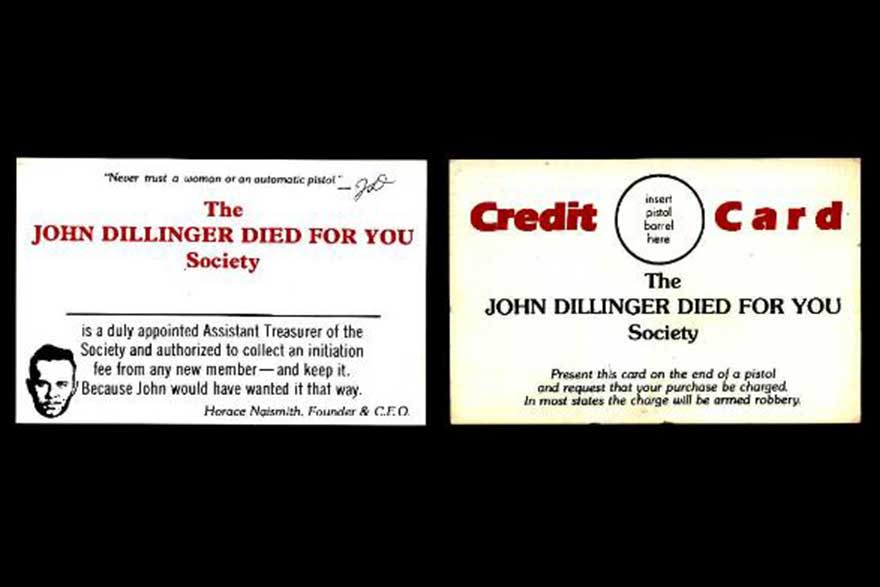
Last night’s vigil was organised by the John Dillinger Died For You Society, one of those 60s counterculture mischief-making enterprises like Discordianism and the Church of the Sub-Genius that I’ve always been rather fond of.  According to Robert Anton Wilson:

The John Dillinger Died For You Society, run by a pseudonymous “Dr. Horace Naismith” (allegedly a Playboy editor by day and a maniac only by night), accepts as its savior John Dillinger, the gunman who robbed 23 banks and three police stations before he was shot dead by FBI agents in 1934. JDDFYS members place memorial wreaths and floral bouquets at the Biograph Theater, where Dillinger was gunned down, every year on the anniversary of his death, June 22. Their major spiritual teaching comes from Mr. Dillinger, whom they call St. John the Martyr, and consists of the words, “Lie down on the floor and keep calm,” (St. John said this often to nervous and agitated bank officials before looting their tills). Every member ordained by Dr. Naismith gets a membership card making him or her an Assistant Treasurer, entitled to collect tithes from any new disciple naive enough to remain a disciple and not become an Assistant Treasurer, too, by writing to Dr. Naismith for a card.

Dillinger certainly had a way with words.  When it comes to quotes and aphorisms, he was something of a cross between Oscar Wilde and Raymond Chandler.  My favourite Dillingerism has always been:

“You get more with a simple prayer and Thompson sub-machine gun than you get from a simple prayer alone.”

As other people smarter than me have noted, this seems to sum up the foreign policy of most countries.

As an antidote to the relentless cavalcade of hubris, hypocrisy and moral indignation stoked up by the cataclysmic faeces-to-fan proximity problem that’s known locally as the MPs’ Expenses Scandal, here’s a little something from the satirist, guerrilla ontologist and former editor of Playboy, Robert Anton Wilson. Its the Third Law of Wilson’s fictional gentleman anarchist Hagbard Celine, and it goes something like this:

An honest politician is a national calamity

At first glance, this seems preposterous. People of all shades of opinion agree that at least on the axiom that we need more honest politicians, not more crooked ones. Please remember, however, that people of all shades of opinion once agreed that the Earth is flat.

Your typical dishonest politician (bocca grande normalis) is interested only in enriching himself at the public expense, a goal he shares with most of his fellow citizens, especially doctors and lawyers. This is normal behavior for our primate species, and society has always been able to endure and survive it.

An honest politician (bocca grande giganticus) is far more dangerous. He or she is sincerely committed to bettering society by political action. In practice, that means by writing and enacting more laws. Indeed, many groups of idealistic citizens publish rating sheets on politicians every year, and those who have created more laws are estimated as having higher value than those who are frequently absent when bills are voted upon. The assumption is that adding more laws to statute books is a positive achievement, like adding more money to our paychecks or more art works to a museum.

A little thought, however, shows that this assumption is not tenable. Every law creates a whole new criminal class; for instance, when marijuana was illegalized in 1937, several hundred thousand formerly law-abiding citizens became criminals overnight, by Act of Congress. As more and more laws are passed, more and more citizens become criminals. The chief cause of the rising crime rate is the rising number of laws being enacted. An honest politician, who keeps his nose to the grindstone and enacts several hundred laws in the course of his career, thereby produces as many as several million new criminals.

It is furthermore mathematically demonstrable that the more laws there are, the more restrictions there are on the freedom of the individual. If there were, say, only three laws in a given society—e.g., Thou shalt not kill; thou shalt not steal; thou shalt not lie or defraud—there would be only three restrictions on freedom, which all rational persons would accept as obviously necessary to the maintenance of order. When there are several hundred thousand restrictions on freedom, most of them are felt as extremely irksome by large segments of the populace.

In fact, it would take a brigade of lawyers several weeks, minutely examining your affairs, to determine if you are a criminal. Certainly, no ordinary citizen has the time or research facilities to discover if he or she is in violation of one out of skillions of laws currently on our statute books. In many cases, two lawyers consulted independently will give opposite opinions about whether or not a given course of action is in violation of the statutes.

And new laws are being enacted all the time. Obviously, unless there is a sudden paper shortage, the number of laws on the books will eventually reach the point satirized by T.H.White, in which “everything not prohibited is compulsory.” It would then probably only take a few years or decades more for a cadre of honest politicians diligently writing even more laws to reach the complementary point where “everything not compulsory is prohibited.”

At that stage the nightmare world of Orwell’s 1984 will be achieved. Crooked politicians, merely interested in the normal human activity of making themselves rich and comfortable, could never create that ultimate horror; but honest and idealistic politicians bring us closer to it every day, with every new law they enact.

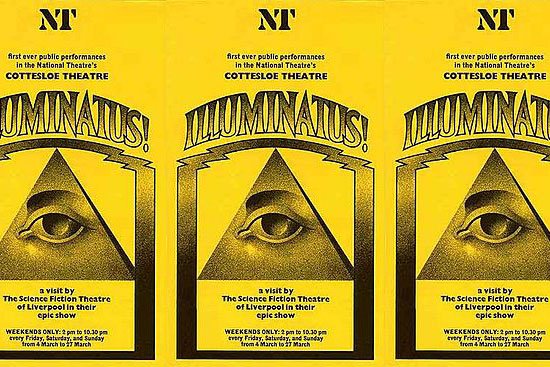
From Robert Anton Wilson – The Illuminati Papers

Please remember: Hagbard Celine is a fictional character. The views and opinions expressed by him are fictitious and do not necessarily represent the views and opinions of Tom Lennon’s Blog or any of its affiliates. This disclaimer, of course, does not necessarily represent the views and opinions of Hagbard Celine.

Step away from the fnord.

Mar 26

Read Yourself RAW

Posted by Tom Lennon in Robert Anton Wilson

I’m currently re-reading – for the umpteenth time, I might add – the great (and, sadly, late) Robert Anton Wilson’s first Cosmic Trigger book. While the title might seem a tad hokey and dated (it was written in 1977), the book itself remains fiendishly clever, gleefully provocative and side-splittingly funny. Like most of RAWs oeuvre, it contains such a generous mindbending-idea-to-page ratio that he makes most other writers, philosophers and social commentators seem cognitively tight-fisted by comparison.

Anyway, a particular passage jumped out at me today. Let me share it with you:

Everybody nowadays thinks they must have an “opinion” on everything, whether they know anything about it or not. Unfortunately, few people know the difference between an opinion and a proof. Worse yet, most have no knowledge at all about the difference between a merely legal proof, a logical or verbal proof, a proof in the soft sciences like psychology, and a proof in the hard physical-mathematical sciences. They are full of opinions, but they have little ability to distinguish the relative degree of proof upholding all these various opinions.

We say “seeing is believing”, but actually, as Santayana pointed out, we are all much better at believing than at seeing. In fact, we are seeing what we believe nearly all the time and only occasionally seeing what we can’t believe.

RAW was very good at codifying, clarifying and articulating the thoughts (and, sometimes, the intellectual prejudices) that many of us have from time to time. What he says here may seem fairly self-evident, at least conceptually.

He also, however, had a mischievous gift for planting in his readers’ heads nasty little neuro-linguistic cluster bombs with time-delay fuses. In the example cited above, we all encounter people/groups/institutions who seemingly can’t distinguish between an “opinion” and a “proof” (let alone make a distinction between the different types of proof…) every time we pick up a newspaper, listen to a politician or subject ourselves to the BBC News website’s Have Your Say page. What’s not so easy, of course, is detecting this sort of thing in your own group, tribe or self.

That includes myself, of course.

Jan 02

MMIX

Posted by Tom Lennon in Robert Anton Wilson

So here we are, at the start of a bright new year; and here I am, thumping the keyboard like a sausage-fingered caveman, trying to hammer out my first blog post of 2009. It’s also my first blog post in almost a month, but who’s keeping track of these things, anyhow?

Something odd has recently occurred to me. Actually, it’s occurred to me at regular intervals over the last eight or nine years, but now’s as good a time as any to share it with others. That’s probably not the best thing to do when something odd occurs to you, especially in the wee small hours of the morning, but at least this way I get to find out whether it’s occurred to others, too. It may even may have occurred to you, in which case we could always pool our resources, split the counselling fees or form a Facebook group.

Anyhow, the oddity that’s occurred to me is this: if, like me, your calendar of choice is the Gregorian calendar then you’ll probably agree that we’re fast approaching the end of the first decade of the 21st Century. Sure, depending on how much of a stickler or a party-pooper you were ten years’ ago, you may have argued over whether the 21st Century kicked off in the year 2000 or 2001. You’ll probably now agree, however, that we’re fast approaching the Kubrick decade’s closing overs and final furlongs. Isn’t it odd, then – in this Year of Our Lord two thousand and nine – we’ve yet to agree on what this decade is actually called?

It was all so straightforward in the 20th Century. There was the Nineties, and before that, the Eighties. Prior to that we had the Seventies, Sixties, Fifties and so on. They were parcels of time, each conjuring up a specific cocktail of imagery and music and history and style. They were arbitrary labels, based on a highly capricious measurement of time that was steeped in Medieval folklore and riddled with sweeping inaccuracies and generalisations.

But at least they had names.

And these weren’t names that were applied after the event. It wasn’t like the way the French Revolution that became known as the French Revolution long after the Storming of the Bastille. People thought of the Nineties as the Nineties during the Nineties, and it was the same for all the other 20th Century decades. At the end of the 90s, for instance, certain musical fads could be described by media pundits as “early-90s” just as, at the end of the 80s, shoulder pads and designer stubble could be described by the fashionistas and those-what-give-a-shit as “very mid-80s.”

So far as I can tell, however, we haven’t settled on a name for this decade we’re living in right now. I’ve heard a few attempts, mind you. “The Noughties” pops up now and then, but to me that sounds a bit too FHM for my tastes. “The Zeroes” is another one I’ve heard on occasion, but that not only contains unfortunate pessimistic conotations, but it also sounds like it should be an indie band (and a quick Google search confirms my suspicions…). For the most part, though, journalists, pundits and proper ordinary people seem to skirt around this issue like its a big temporal elephant in the room.

But I don’t this to turn into one of those rants by middle aged bloggers who moan about what’s wrong with things without offering any alternatives. At least not with this post. In the interests of bringing something to the table and opening up a debate on the subject here’s my suggestion for a name tag for this decade: “The Norts”. It’s catchy, and it’s free of the aforementiontioned connotations and the fact it will resonate with fans of the character Rogue Trooper from the great British comic 2000ad is an added bonus.

Of course, these labels are all based on the Gregorian calendar, which has always been my calendar of choice (from my experience, most people don’t realise there’s more than one calendar to choose from). If your calendar of choice isn’t the Gregorian calendar then it probably isn’t the first decade of the 20th Century for you. According to the nifty calendar converter I found here, today – 3rd January, 2009 – is:

7 Teveth 5769 according to the Hebrew Calendar
6 Muharram 1430 according to the Islamic Calendar
15 Kankin or 12.19.15.17.12 according to the Mayan calendar
Duodi, 12 Nivôse 217 according to the French Republican Calendar

And my favourite:

Pungenday, Chaos 3, Year of Our Lady of Discord 3174 according to the Discordian calendar.

Maybe I should think about switching brands.

Oct 15

"All that is, is metaphor"

Posted by Tom Lennon in Robert Anton Wilson

From YouTube, a condensed version of Robert Anton Wilson’s Maybe Logic DVD:

“RAW talks about the sanity of using maybe, E-Prime (the english language without IS or Being), imprinting and conditioning, optimism, awakening and how ‘the map is not the territory‘.”

Well, whaddaya know. I didn’t even know there was a Maybe Logic DVD, let alone a condensed version of it.

Robert Anton Wilson (1932-2007) will always be one of my favourite writers. I spent a large chunk of my 20s trying to hunt down and devour just about every goddamn book he ever wrote. In the days before Amazon, this was no mean feat. By contrast, I stumbled upon the above clip after spending ten minutes or so loitering on the superinformation highway.*

It’s at times like this that I love YouTube.

* Is it still called “the superinformation highway”? I’ve got a feeling that I just made myself sound very Windows 98.

Jun 24

The Magnificent Seven

Posted by Tom Lennon in Robert Anton Wilson

George Carlin was part of a very fine and very respectable American tradition – that of the painfully funny and dangerously smart freethinking foul-mouth. Many of my heroes belonged to this tradition, and it seems like most of them are now dead. Comics like Carlin and Bill Hicks – and writers like Robert Anton Wilson – didn’t just tell jokes or write comedy, they moulded neuro-linguistic smart bombs with a time-delay fuse, designed to perplex you for months or even years as you find yourself thinking hard about why you laughed so hard in the first place.

Carlin wasn’t that well known in the UK, but I couldn’t help but notice how a lot of the mainstream local coverage of his death has been somewhat coy and evasive. The BBC News website announced that:


“Grammy-award winning comedian George Carlin, best known for his Seven Words You Can Never Say On TV routine, has died of heart failure aged 71.

The story said quite a lot about his most infamous monologue. It mentioned how “his Seven Words routine led to his arrest in 1972 for disturbing the peace after he performed the act at a show in Milwaukee.” It also told the famous story of the New York radio station that played a recording of the Seven Words, which resulted in “a Supreme Court ruling in 1978 upholding the government’s authority to sanction stations for broadcasting offensive language.”

The one thing the BBC didn’t mention is what the Seven Words You Can Never Say On TV actually were.

Would you like to know what they were?

George Carlin’s Seven Forbidden Words were shit, piss, fuck, cunt, cocksucker, motherfucker and tits.

I first read about this in the late Robert Anton Wilson’s excellent book, Quantum Psychology. In it, he devotes a chapter to Carlin and the neurolinguistic hallucinations we associate with “bad” language. Like much of Wilson’s work, it’ll make you laugh like an idiot.

It’ll also perplex you for months.

That, in case you don’t know, is a Waiticism – a quote by the legendarily quotable singer-songwriter Tom Waits. Like many of Waits’ lines I’ve used it at numerous society events and apologise now for giving anyone the impression that I’d invented it myself. I did, however, coin the phrase Waiticism. It’s not one I’m particularly proud of.

I picked up Friday’s Independent because it had an interview with Waits. It turns out I’d already read it on his record label’s website, but that didn’t stop me from reading it again. Like his recent press conference, it plays fast and loose with the traditional rules of the interview format. For one thing, he asks himself the questions.

Needless to say, it’s full of sublime wit and is tremendously entertaining:

Q: Do you have words to live by?

A: The director Jim Jarmusch once told me, “Fast, Cheap, and Good… pick two. If it’s fast and cheap, it won’t be good. If it’s cheap and good, it won’t be fast. If it’s fast and good, it won’t be cheap.” Fast, cheap and good… pick two words to live by.

Q: What do you wonder about?

A:

1. Do bullets know whom they are intended for?
2. Is there a plug in the bottom of the ocean?
3. What do jockeys say to their horses?
4. How does a newspaper feel about winding up papier-mâché?
5. How does it feel to be a tree by a freeway?
6. Sometimes a violin sounds like a Siamese cat; the first violin strings were made from catgut – any connection?
7. When is the world going to rear up and scrape us off its back?
8. Will we humans eventually intermarry with robots?
9. Is a diamond just a piece of coal with patience?
10. Did Ella Fitzgerald really break that wine glass with her voice?

My favourite bit, though, isn’t actually a Waiticism as such. Rather, it’s his favourite quote from the architect, designer, futurist and all-round polymath that was R. Buckminster Fuller. To wit:

“Fire is the sun unwinding itself from the wood.”

That, my friends, is poetry. I’ve been a big fan of Bucky Fuller since discovering his work and theories via the late, great Robert Anton Wilson. I didn’t realise until this interview that Waits’ was a fan, too. I like it when that happens.

Anyhow, there’s more good stuff about the interview here.

Nov 19

Many Small Worlds

Posted by Tom Lennon in Robert Anton Wilson

I’ve liked the band Eels ever since I listened to their Beautiful Freak album ten years or so ago. I’ve never seen them live, but they’re touring now so I might try to catch them.

The reason why I mention this somewhat tedious factoid is that I just saw a trailer on BBC4 for a forthcoming doc about Eels frontman Mark Oliver Everett. It turns out that his father was Hugh Everett – he of the Everett-Wheeler-Graham school of quantum physics.

Robert Anton Wilson’s bloody marvellous Schrödinger’s Cat Trilogy is what first got me interested in quantum physics. Here’s how he described the Everett-Wheeler-Graham model in the appendix:

An alternative to Bell’s Theorem and the Copenhagen Interpretation. According to Everett, Wheeler & Graham, everything that can happen to the state vector does happen to it.

To put it another way, then, the father of the frontman of the Eels’ was the brains behind the Many-Worlds Interpretation of quantum mechanics. That’s mad, that is. It’s positively buggier than batshit.

Incidentally, I first read RAW’s Schrödingers Cat Trilogy at about the same time as I was first listening to Eels’ Beautiful Freaks album.

Typical, huh?