Despite his reputation as a beer-drinking, cigarette-smoking, odd-faced man of the people, the notorious British fascist leader Sir Archibald “Archie” Flagstaff (1894-1982) had a privileged upbringing, far removed from the vast majority of his supporters who still had to use a toilet in the backyard.
Flagstaff was born in the maternity wing of his family’s vast country estate in Mayfair, which famously housed the world’s first (and indeed last) 53,000-seater croquet stadium. As a child, he attended Goosestep Prep, an experimental, regressive school that focused on “the 3 R’s”: reading, rioting, and racism.
He studied under the school’s controversial bigotry tutor, Sir Colin Cone, who instilled in the boy a strong sense of racial intolerance, anti-intellectualism, and tax avoidance. It was Master Cone who taught an impressionable young Flagstaff that the best form of communication was to lie, cheat, and deny everything. When Flagstaff asked him to elaborate, Cone replied, “Who told you I said that? I never said that.”
At 13, Flagstaff was enrolled at Dangleberry Prior, a private boarding school for boys that was so upmarket it had an offshore tuckshop and employed dinner ladies-in-waiting. Unlike Goosestep Prep, the school welcomed students of all races and walks of life, provided their parents could afford the termly tuition fee, which was a Fabergé egg.
While he was a star pupil at Goosestep Prep, Flagstaff was unpopular among Dangleberry’s students and teachers because he often bullied them. He was appalled by what he perceived as the school’s “anti-white” approach to millionaire multiculturalism and regularly disrupted Latin classes with cries of “Speak English!” Flagstaff was suspended on twenty-seven separate occasions for refusing to wear a school blazer, often turning up to class in a frilly silk doublet, tricorn hat, and jodhpurs. Most historians now agree that this was not a political statement but rather an attempt to sabotage the school’s weekly laundry with running colours.
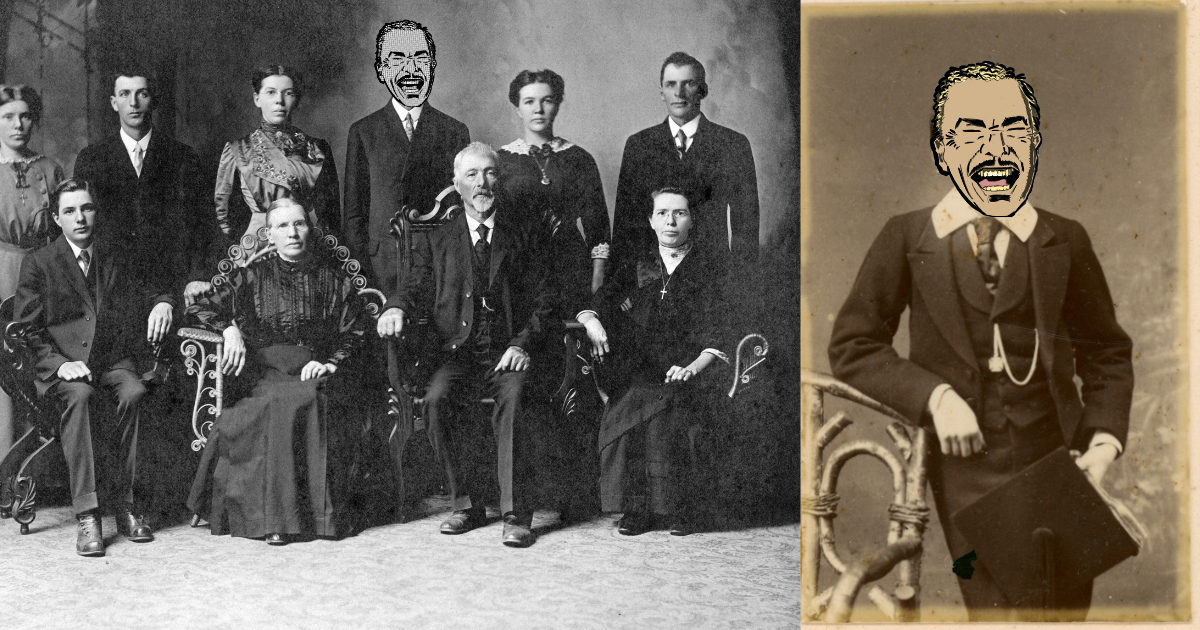
Young Archie Flagstaff
Left: Archie Flagstaff (top row, middle) pictured with his mother, father, household staff, and security detail, circa 1907. Right: Flagstaff graduating from Dangleberry Prior Boarding School, 1913 (Images: Canva/imagesbybarbara/Getty Images Signature/duncan1890/Tom Lennon)
After Dangleberry, Flagstaff studied at the London School of Exploitation, where he was awarded a BA in Advanced Authoritarianism and Popular Populism. His 1914 graduation ceremony was interrupted by the outbreak of the First World War, but Flagstaff managed to avoid military service by feigning a limp. This was a Flagstaff family tradition that could be traced back to his ancestor, Sir Francis Flagstaff, whose imaginary gammy knee kept him out of the Hundred Years’ War.
Like many rich people, Flagstaff held a lifelong conviction that war might indeed be glorious and necessary, but it was a bit of a mug’s game. He described himself as a “semi-conscientious objector,” staunchly pro-war while conscientiously objecting to risking his own neck. All that violence and sacrifice, he felt, was best left to the working classes, as it gave meaning to their otherwise miserable lives. “In many ways,” he later said, “I’d be doing them all a favour.”
He later regretted this ruse, as he had to maintain a convincing hobble in public throughout the First World War. In his autobiography, They’ll See I Was Right (1962), he claimed that dragging his leg around in public for four long years was, in many ways, a greater sacrifice than serving in the trenches because “at least there I could have written some poetry and impressed the birds.” For the rest of his life, his legs experienced involuntary muscle spasms whenever he was in the presence of military personnel. Psychologists later diagnosed this as a legacy issue.
After the war, Flagstaff pursued a political career, becoming a Tory Member of Parliament for the safe seat of South Booster. He later claimed he was targeted by “radical leftist deep-state operatives” at Conservative Central Office, who were hostile to his extreme politics, his wartime cowardice, and the fact that he bullied them at Dangleberry Prior.
In 1922, Flagstaff defected to the Liberal Party, sparking anger among his constituents who were forced to defect to the Liberal Party, too. Within weeks, he got into a blazing row with Liberal Prime Minister David Lloyd George about moustaches. Lloyd George had offered Flagstaff a senior cabinet position, but on the condition that he’d get rid of his signature pencil moustache (Lloyd George famously hated pencil moustaches, describing them as “Satan’s whiskers”). He ordered Flagstaff to make an appointment with the House of Commons barber and “have the damnable thing shaved off” or, at the very least, “replaced with something bushier.”
In his diary, Flagstaff wrote that Lloyd George’s hostility to his slender mouth-brow was “by far the worst case of political persecution this country has ever seen.” On his way to the barbershop the next morning, Flagstaff had a sudden change of heart and defected to the Labour Party. This, too, was short-lived, as they expected him to work occasional weekends.
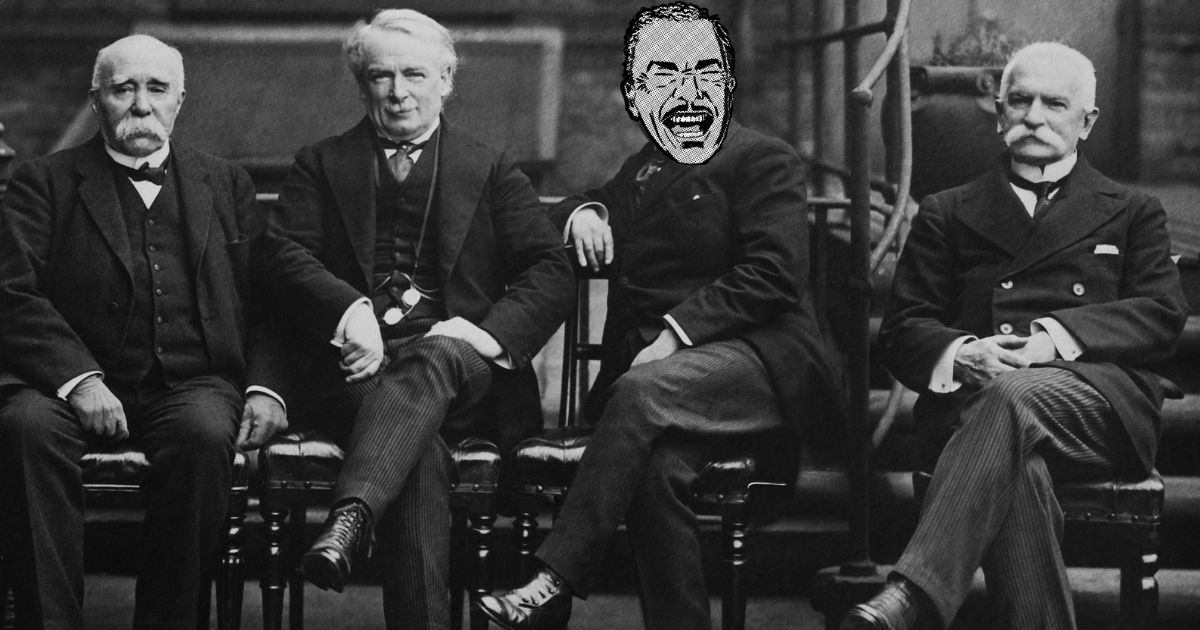
Flagstaff's Political Beginnings
Archie Flagstaff (middle) pictured with David Lloyd George and two high-ranking international politicians with impressive moustaches (Versailles, 1919; Images: Canva/The Everett Collection/Tom Lennon)
Flagstaff spent most of the decade in the political wilderness, but the rise of authoritarian movements in Germany and Italy reawakened his childhood fondness for fascism. He remembered those happy days at Goosestep Prep, terrorising smaller boys through brutal games of divide-and-conkers. In a 1928 diary entry, he wrote, “If only I could find some way of turning my schoolyard bullying antics into a broader political movement, perhaps by convincing people that everything used to be better in the old days and it’s all the fault of some convenient racial and political scapegoats. I could then offer myself (reluctantly, of course) as the only sensible solution.” He believed this approach would fast-track his political revival, and he wouldn’t even have to change his moustache.
He sent telegrams to Mussolini and Hitler, and the three became firm pen pals, bonding over a shared love of croquet and cruelty. They were happy to help Flagstaff achieve his political goals, and soon newspapers across Britain were inundated with letters from angry readers who no longer recognised their country, possibly because most of the letters had Bavarian postmarks.
Flagstaff’s newfound dictatorial besties also urged him to look beyond Britain’s tired old three-party system and build his own political alternative. Heeding their advice, Flagstaff launched the British Fascist Party and Sons, a family business dedicated to ultranationalism and violence. This new political force in British politics was partly funded by Flagstaff’s personal wealth and a generous new business start-up loan from the Nazis.
With help from Joseph Goebbels, the dictatorial duo also coached Flagstaff in the fine art of public relations. He began smoking and drinking in public, pretending to like football, and adopting era-appropriate working-class expressions such as “Stone the crows!” and “Cor blimey, Mary Poppins.” He also abandoned his posh-sounding first name, Archibald, in favour of Archie, a change Goebbels believed would give him a more down-to-earth, common touch.
This (along with his racism) convinced many British voters to overlook his ridiculously privileged background and embrace him as a straight-talking, short-tempered man of the people who spoke his mind. “Archie’s only saying what everyone else is thinking,” said Bert Chestnut, a retired viaduct sweeper from Wigan. “He’s earned that hereditary peerage and inherited croquet stadium, not like those bleeding foreigners coming over here, taking the jobs we don’t want and building our infrastructure.”
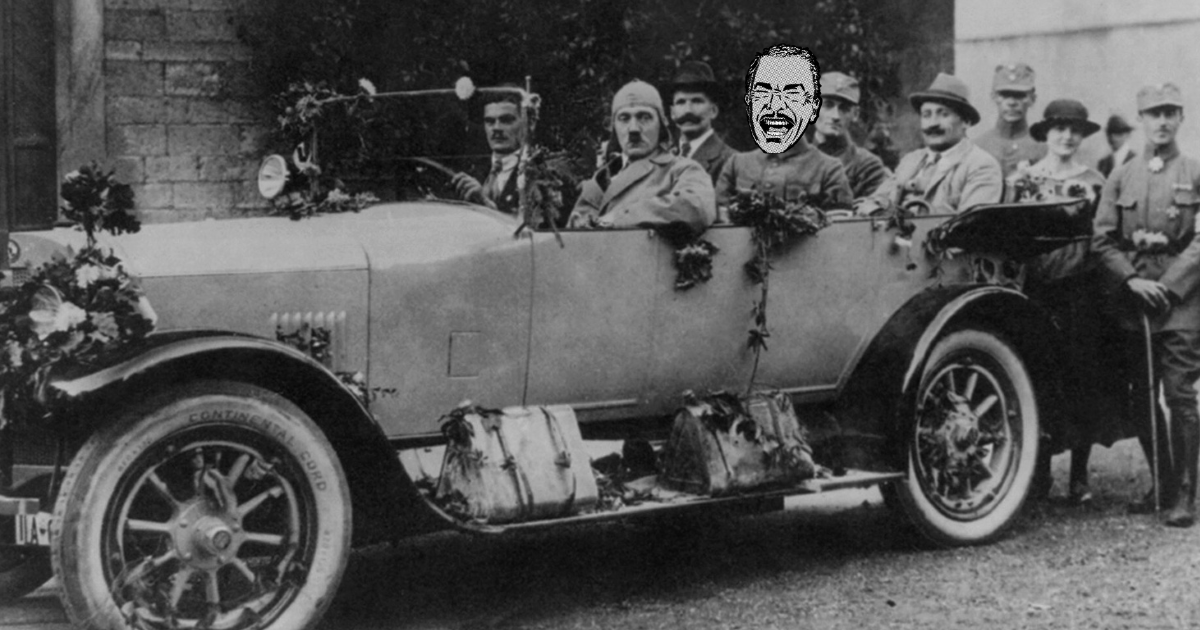
Archie Flagstaff's Stag Night
Munich, 1931: Archie Flagstaff with Adolf Hitler and Benito Mussolini in a rented open-top Mercedes-Benz (a drunken Mussolini was asleep in the trunk). Please note that this was one of the rare occasions when the Führer was photographed wearing a knotted handkerchief on his head. (Image credit: Canva/The Everett Collection/Tom Lennon)
Flagstaff’s personal life was every bit as promiscuous as his political life. He married Lady Harriet Walthamstow in 1920 but had affairs with her sister, stepmother, best friend, cousins, aunts, and members of her local Women’s Institute. When Lady Harriet died in 1931 after mysteriously falling up a flight of stairs, Flagstaff had her buried in the grounds of his croquet stadium for tax purposes.
Within days, he married Margaret “Peggy” Sledge, with whom he’d been having an affair for several parliamentary sessions. She was the eldest of the famous Sledge Sisters, three aristocratic celebrity siblings renowned for their scandalous exploits and opposing political ideologies. Peggy was a devout fascist, Millie a hardline communist, while Felicity would later become treasurer of the Official Monster Raving Loony Party.
Their wedding took place in Nazi Germany, with Hitler and Mussolini as guests of honour. Historians had long believed that the three men hatched a plan to establish a network of fascist-aligned, Peaky Blinders-style gangs during Flagstaff’s Munich Bierkeller stag-do. Recently unearthed documents, however, suggest that their wives – Peggy Sledge, Eva Braun, and Rachele Guidi – had actually come up with the idea during the hen-do, and that their husbands subsequently took all the credit.
All three women were driven by revenge following disastrous love affairs with Peaky Blinders gang leader Thomas Shelby, who confessed that he was a composite character based on several real people and therefore could not pay for their hotel rooms. Flagstaff would later use the same excuse with many of his own mistresses.
His gangs became collectively known as “Turquoise shirts” largely because rival fascist leaders had already laid claim to more intimidating colours. Unfortunately, Flagstaff underestimated the cost of maintaining a vast network of fascist street militias and, as a result, was forced to lease his beloved croquet stadium to a local Sunday League football team, the Mayfair Proletariats.
Worse was to come. Flagstaff’s street militia project ended abruptly during the Battle of Cable Street (1936), when his gangs – including the Geeky Brothers, Freaky Preachers, and Shrieky Grifters – were beaten senseless by a coalition of Jewish groups, anti-fascists, and proto-feminist gangs like the Meaty Grinders. In 1937, his wife Peggy and sister-in-law Millie set sail for Barcelona on their family yacht to fight in the Spanish Civil War on opposing sides. The sisters returned home in 1938 due to injuries sustained after they accidentally shot each other during a shopping trip to Madrid.
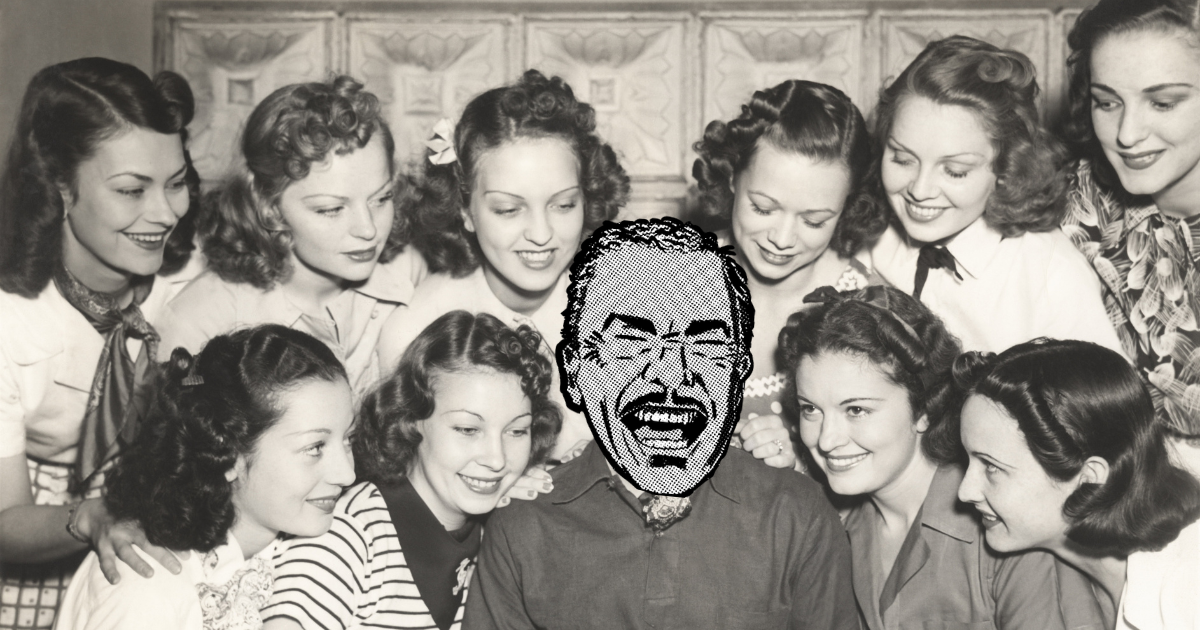
Flagstaff's Women
Flagstaff was considered quite a ladies' man, despite having a face like a hateful, gurning trout. (Image credit: Canva/The Everett Collection/Tom Lennon)
Despite his numerous romantic liaisons, Flagstaff was not, by any means, a classically handsome man. Chubby xenophobe Winston Churchill likened his face to “a misshapen cream bun that had been rolled around the floor of an East End barbershop” and his infamous body odour to “the reek of boiled cabbage wrapped in yesterday’s Daily Express.” Flagstaff was 5’6” but became obsessed with his height when he realised that, while he was on the same level as Mussolini, he was still three inches shorter than Hitler. As a result, he always felt he was in the Fuhrer’s shadow.
Flagstaff also suffered from omnidirectional male-pattern baldness, with his hair receding in all directions, including diagonally. He wore a toupee from the age of 11, then spent the rest of his life angrily denying it, even when the wash care label was clearly visible dangling above his brow. To make matters worse, his trademark pencil moustache did little to conceal the massed ranks of herpes cold sores along his upper lip.
In 1939, Britain declared war on Nazi Germany, and Hitler regarded Flagstaff as an ideal candidate for a post-invasion Regional Dictator, subject to satisfactory references and successful completion of a six-month probationary period. To lay the groundwork, Hitler sent Flagstaff monthly payments in untraceable gold nuggets smuggled into Britain in fishing boats disguised as jellied eels. In 1940, Flagstaff was placed under house arrest after attempting to deposit the gold nuggets into his bank account, which aroused a clerk’s suspicions because many of them were shaped like teeth. Humiliated by the scandal, he retired from politics, claiming a rotator cuff injury prevented him from performing fascist salutes.
He spent the post-war years as an unsuccessful commodities broker and real estate tycoon. Flagstaff died in 1982 after a long battle with general paresis of the insane, a condition resulting from decades of untreated syphilis. He was survived by his wife, Peggy, and his sons Hermann, Heinrich, and Adolf.