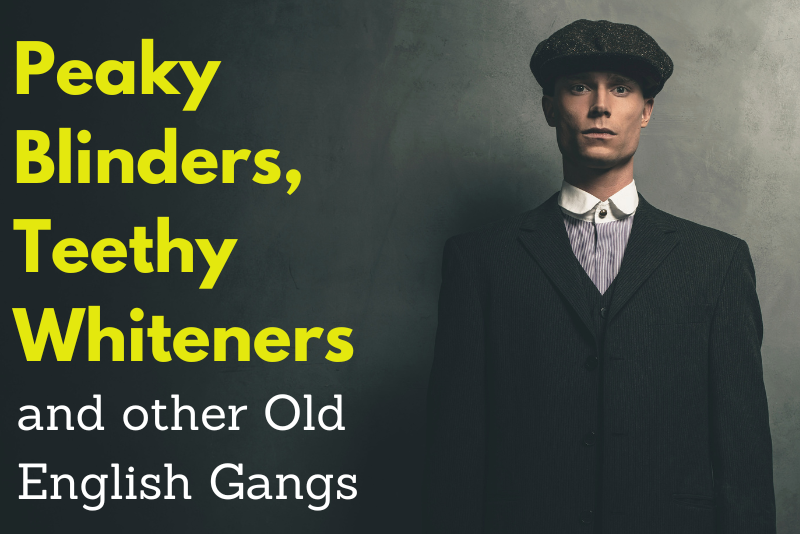
In recent years, the once-unfashionable English second city of Birmingham has undergone a dramatic transformation thanks to a TV show about an olde worlde street gang notorious for their high cheek-bones and weaponised hats.
Fans of the hit drama series Peaky Blinders have been flocking to the city in huge numbers, often traveling from across the world while dressed as Birmingham landmarks. A city once synonymous with industry, curries, and heavy metal music is now best known for its abundance of Peaky Blinder-themed pubs, nightclubs, and soft play centres.
Though inspired by real events, Peaky Blinders weren’t Britain’s only colourfully-named, Netflix-ready gang of sociopaths. Here’s a brief overview of some of Britain’s most notorious thugs:
Streaky Bakers

Image: © gerenme from Getty Images Signature via Canva.com
Long before the Great British Bake Off captivated an easily-distracted nation, this seemingly harmless prime-time pastime once had an altogether more sinister appeal. For decades, the sleepy Derbyshire town of Bakewell was home to illegal backstreet bake-offs, where muscular, barely-literate amateur bakers would compete against each other for cash, honour, and yeast. Part of the same underground scene that introduced the world to bare-knuckle knitting and illegal jam distilleries, the bake-offs became a focal point for illegal gambling dens run by gangs of unscrupulous cook-makers (or ‘cookies’ for short). The most vicious of these were the Streaky Bakers, who often rigged the outcome of bake-offs by breaking crusts, soggying bottoms and, quite literally, ‘cooking the books’. Their name is derived from the fact that they didn’t wear clothes.
Cheesy Rollers
Background images: © fotokris from Getty Images and Billion Photos via Canva.com
In the 1820s, Lincoln’s Cheesy Rollers were a group of free-thinking radicals who attacked the ruling elite through dairy products. At the dead of night, they’d surreptitiously transport an immense wheel of cheese to the peak of the city’s Steep Hill district, before letting it roll towards unsuspecting gatherings of toffs and poshos who’d be scattered like top hat-wearing skittles.
The Cheesy Rollers were denounced by Lord Liverpool’s government, which was notoriously lactose-intolerant. The gang captured the imagination of the British public, however, and even got namechecked in a famous couplet by Shelley:
I saw freedom o’er there
It had a whiff of camembert
In 1848, popular opinion soon turned against the movement when a huge Red Leicester en route to a robber baron convention veered off-course and crashed into a party of picnicking nuns. Wreckage recovered from the cheese debris proved that faulty tracking was to blame, but the gang was still rounded up, tried without a jury, and then exiled to faraway East Anglia.
Despite all this, their legacy endured. A century later, the American folk singer Woody Guthrie wrote ‘Ballad of a Cheesy Roller’ which featured the rousing chorus:
What’s that coming over the hill?
Is it a Gloucester? Is it a Gloucester?
Teethy Whiteners
Background image: © busracavus from Getty Images Signature via Canva.com
The gang’s name referred to their favourite form of punishment, which involved forcibly whitening their enemies’ teeth with a special blend of peroxide and bicarbonate of soda. This would render the victim a social outcast in an era characterised by dark, tanned gnashers.
Creepy Monsters

The gang – dressed in tawdry Pierrot costumes – would loiter around bulldozers, taunting passers-by with obsolete video effects and sinister chants of “You’d better not mess with Major Tom.” As the situation escalated, Bowie himself intervened, making numerous peacekeeping visits to Beeston and Gedling despite his widely publicized fear of Brian Clough.
Bowie’s efforts, however, only inspired the formation of even more extreme tribute gangs, such as the Bowie/Jagger-influenced ‘Streety Dancers’ and the Bowie/Queen-themed ‘Undie Pressers’.
Exasperated, Bowie took drastic steps to distance himself from these gangland connections by forming the band ‘Tin Machine.’